Secondo le rilevazioni di Fruitimprese, su dati Istat, l’export italiano di ortofrutta fresca archivia il primo trimestre 2026 con un incremento del 7,6% in valore rispetto allo stesso periodo del 2025, nonostante una lieve flessione dei volumi (-0,9%).
A sostenere il risultato sono soprattutto le performance della frutta fresca e della frutta secca, mentre pesa il calo degli agrumi. Sul fronte delle importazioni, i quantitativi restano sostanzialmente stabili (+0,5%), con un aumento del valore del 5,9%. Il saldo commerciale supera i 360 milioni di euro, in crescita del 15,3% su base annua.
Kiwi protagonisti, agrumi in difficoltà
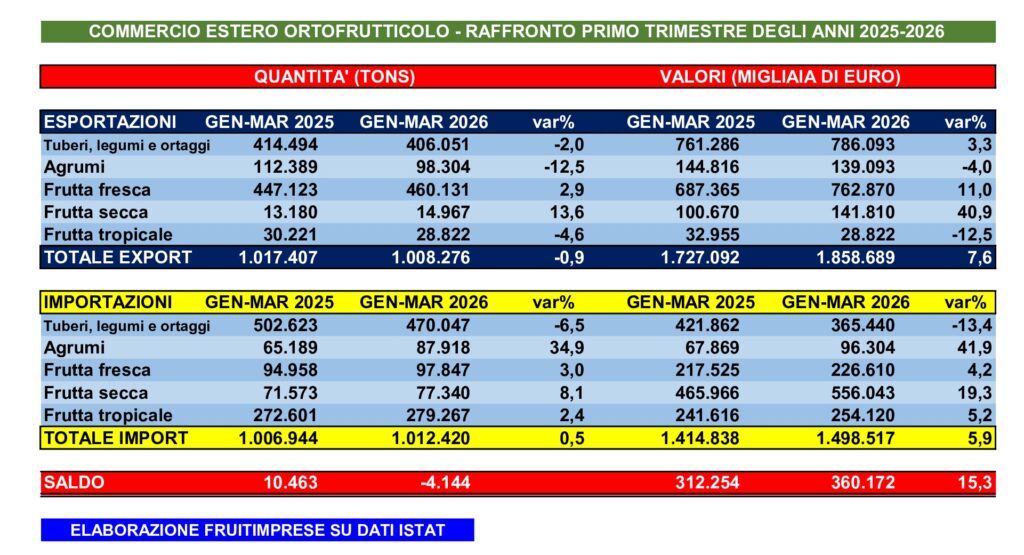
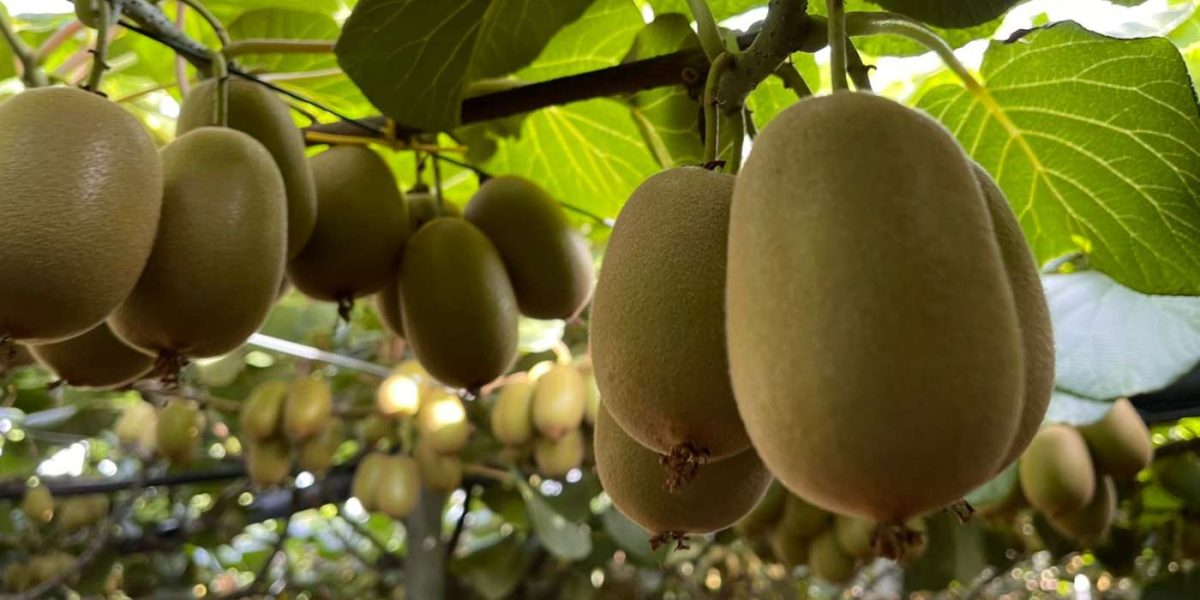
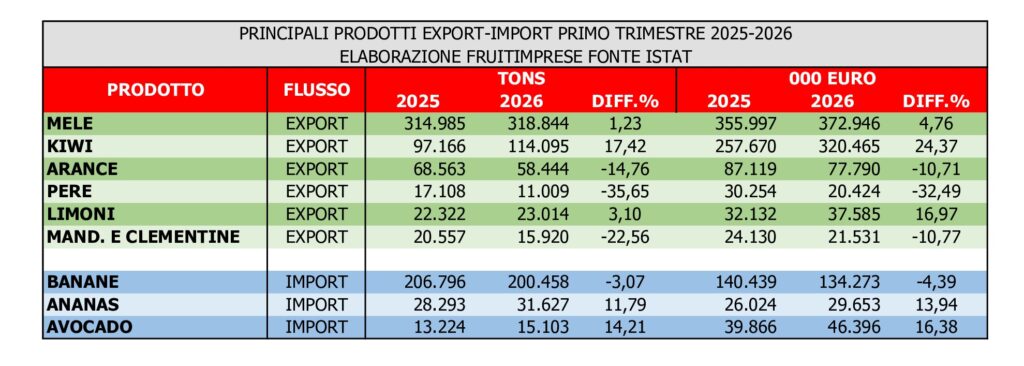
Nonostante gli effetti della crisi nello Stretto di Hormuz e le ripercussioni sui mercati asiatici, le esportazioni di frutta fresca registrano un aumento del 2,9% in volume e dell’11% in valore, trainate da una campagna particolarmente positiva dei kiwi.
Anche la frutta secca mostra un andamento molto favorevole, con una crescita del 13,6% nei volumi e del 40,9% nei valori.
Scenario opposto per gli agrumi. Le esportazioni segnano una contrazione del 12,5% in volume e del 4% in valore, conseguenza delle perdite produttive causate dal ciclone Harry durante la raccolta.
Tra i principali prodotti esportati si confermano le mele, in crescita dell’1,23% nei volumi e del 4,76% nei valori. Spiccano soprattutto i kiwi, che superano le 114 mila tonnellate esportate, con un incremento del 17,42% in volume e del 24,37% in valore.
Continua inoltre la fase critica delle pere, le cui spedizioni all’estero crollano di oltre il 30%.
Importazioni in ripresa per avocado e ananas
Tra i prodotti più dinamici dell’import, si segnalano ananas e soprattutto avocado, che conferma il proprio ruolo di riferimento tra i consumatori italiani grazie a una crescita del 14,21% nei volumi e del 16,38% nei valori.
Nuove destinazioni commerciali e incognite normative
Secondo il presidente di Fruitimprese, Marco Salvi, i dati dei primi tre mesi dell’anno restituiscono l’immagine di un settore ancora in espansione, ma esposto a fattori di forte instabilità internazionale.
Per affrontare il nuovo scenario, molte imprese stanno valutando mercati alternativi per la prossima campagna commerciale. Tra le opzioni considerate figurano il Brasile per le mele, grazie al Mercosur, e gli Stati Uniti per i kiwi.
Salvi evidenzia inoltre il risultato ottenuto dalla recente missione istituzionale in Sudafrica guidata dal ministro Francesco Lollobrigida, che ha aperto all’export italiano di uva da tavola verso il Paese africano.
Le preoccupazioni degli operatori riguardano anche il quadro regolatorio europeo. Dal 12 agosto dovrebbero entrare in vigore i primi obblighi previsti dal regolamento Ppwr, che introduce nuovi requisiti per gli imballaggi commercializzati nell’Unione europea, compresa la certificazione relativa all’assenza di Pfas e di alcuni metalli pesanti.
Consumi stabili e attenzione alla filiera
Sul mercato interno, i consumi del primo trimestre risultano sostanzialmente allineati a quelli dello scorso anno, interrompendo però il trend di crescita registrato nel 2025. Una dinamica che, secondo l’associazione, risente dell’aumento dei costi energetici e logistici.
Fresh Fruit and Vegetables Exports are Growing despite Tensions. New Challenges for Businesses
In the first quarter, an increase by +7.6% in value was recorded. Salvi (Fruitimprese): ‘New trade agreements and AETs will support competitiveness’
Italian fresh fruit and vegetables exports continue to grow despite international tensions related to the Strait of Hormuz crisis and its repercussions on Asian markets. Fruitimprese data, based on ISTAT data, shows that in the first quarter of the year, this sector recorded an increase by +7.6% in value compared to the same period in 2025, despite a slight decline in volumes (-0.9%). This result follows a record 2025 for the sector: Italian exports reached 6.68 billion Euros, with an increase by +11% compared to 2024, while volumes stood at 3.92 million tons (+8.1% year-on-year). Fresh fruit was the main driver of performance in the first three months of the year, recording an increase by +2.9% in volume and +11% in value. Apples confirmed their role as the leading export product, with an increase by +1.23% in exported quantities and +4.76% in value. Kiwis performed even better, exceeding 114,000 tons exported, marking a jump of +17.42% in volume and +24.37% in value. Citrus fruits, however, performed differently. Exports decreased by -12.5% in volume and -4% in value. The pear crisis also continues, with shipments dropping by more than -30%. Dried fruit, on the other hand, performed well, recording an increase by +13.6% in volume and +40.9% in value. Marco Salvi, president of Fruitimprese, stated: ‘Despite a very critical geopolitical situation and the closure of some markets, Italy is demonstrating that its businesses are active and dynamic. Companies are bringing the most innovative products and varieties to international markets: this effort in innovation is being rewarded, especially in terms of cultivars and organoleptic quality’. Salvi explained that the increase by +7.6% recorded in the first quarter confirms the vitality of the domestic fruit and vegetables sector, but consolidating growth will require new commercial outlets, faster phytosanitary protocols, agreements based on reciprocity, and innovative tools capable of supporting business competitiveness.
Phytosanitary openings and new outlets
In this context, phytosanitary agreements take on a crucial role in expanding export destinations. Among the most recent achievements, South Africa’s approval of Italian table grapes, obtained thanks to an institutional mission led by Minister Francesco Lollobrigida, and the launch of Italian kiwifruit exports to Vietnam starting July 1st, as announced by CSO Italy, are noteworthy. Fruitimprese is now following negotiations for Mexico and China’s access to national apple production. The Mexican dossier also includes pears. ‘Mexico is an apple importer, while China, despite producing three times what we do in Europe, is still interested in high-quality imported products. This represents a potential opportunity for club apples and new varieties’.
Businesses are also evaluating new markets for the upcoming marketing campaign. The United States for kiwifruit and Brazil for apples are among the most promising destinations, also in light of the opportunities offered by the agreement between the European Union and Mercosur. According to estimates by Teha, the agreement could allow Italian agri-food exports to reach 1.2 billion Euros approximately, with a potential increase by +155% compared to current levels. In this scenario, the South American common market would become the fourth largest non-EU trading partner for Italian agri-food products. Fruitimprese reiterated its support for free trade agreements, provided they are built on truly equal terms. ‘We have always considered trade to be the soul of a Country’s economy and development. We are in favor of signing free trade agreements, but they must unconditionally respect the principle of reciprocity’. Reciprocity, according to Salvi, must also apply to European policies on the environment, labor, and agricultural production. ‘When Europe raises the bar on quality, the environment, and workers’ rights – all of which are sacrosanct principles – it must demand that the same conditions be applied to products imported from abroad’.
European critical issues: packaging, bureaucracy, and active ingredients
On the domestic front, operators are paying close attention to the progressive tightening of European regulations on the use of active ingredients. Added to this are the initial obligations introduced by the PPWR Regulation, which came into force this summer and includes new requirements for packaging marketed in the European Union, including certification of the absence of PFAS and certain heavy metals. The measures also include a ban on plastic packaging for fresh fruit and vegetables weighing less than 1.5 kilograms: ‘Fruit and vegetables represent only 1.5% of plastic packaging for food products: we are talking about a minimal share’. The president of Fruitimprese also highlighted the critical issues related to bureaucracy and agrochemicals. ‘We must avoid being overwhelmed by bureaucracy or by the desire to be leaders on issues that the market has not yet metabolized or does not require’. As for agrochemicals, the request is not to eliminate available substances without having concrete solutions for producers; this principle was enunciated by Commissioner Hansen himself in his inaugural speech. ‘We must stop the elimination of active ingredients in agriculture until there are valid alternatives for producers. We cannot prohibit an Italian, Spanish, French, or German producer from using an active ingredient and then allow the entry of products from South America or North Africa in which that same ingredient has been used’.
On the other hand, the judgment on Assisted Evolution Techniques (AETs), which have received the final green light from the EU Parliament, is positive. ‘They can be an immediate alternative: they allow us to accelerate in the laboratory what already occurs in nature. They are non-GMO techniques that can promote the creation of more resistant plant material and reduce the use of chemicals. It is a valid alternative solution: this is the direction we must move in’.