Il 2025 segna un nuovo record storico per l’export italiano di ortofrutta fresca. Secondo i dati diffusi da Fruitimprese, le esportazioni hanno raggiunto il valore di 6.683.159.045 euro, in crescita dell’11% rispetto al 2024, mentre i volumi hanno toccato 3.922.204 tonnellate, con un aumento dell’8,1% su base annua.
Parallelamente crescono anche le importazioni, che registrano un +7% in quantità e +14,9% in valore. Il saldo commerciale italiano resta positivo ma si riduce, fermandosi a 408,2 milioni di euro, in calo del 26,8% rispetto al 2024. Rimane invece negativo il saldo in volume (-195.960 tonnellate), seppur in lieve recupero (+7,7%).
Frutta in forte crescita, mele oltre 1 milione di tonnellate
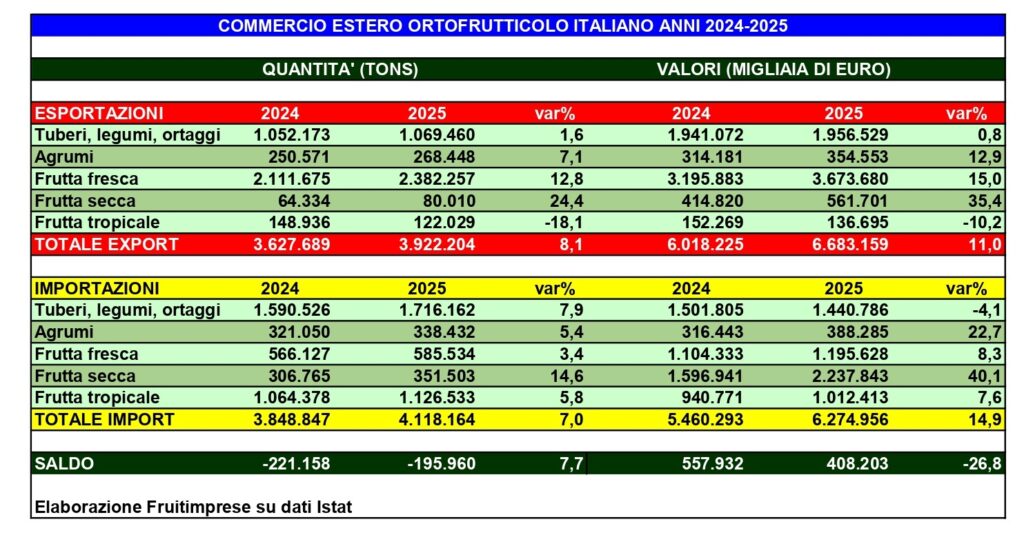
La dinamica più brillante riguarda la frutta fresca, che registra un aumento del 12,8% nei volumi e del 15% nel valore. Positivo anche il comparto degli agrumi, con +7,1% in quantità e +12,9% in valore.
Tra i prodotti simbolo dell’export italiano spiccano le mele, che superano per la prima volta la soglia di 1 milione di tonnellate esportate (1.056.986), in crescita del 17,24%. Restano inoltre il prodotto leader anche a valore, con oltre 1,1 miliardi di euro (+16,03%).
Ottime performance anche per:
- kiwi, in crescita del 19,81% in volume e del 26,45% in valore, con un contributo all’export vicino ai 700 milioni di euro, sostenuto anche dall’espansione delle varietà gialle e rosse;
- uva da tavola, che segna +16,25% in volume e +8,47% in valore, nonostante alcune criticità qualitative durante la campagna;
- limoni, protagonisti tra gli agrumi con un incremento di oltre il 40% sia nei volumi sia nel valore.
Andamento più articolato per altri prodotti: pesche e nettarine calano nei volumi (-6,93%) ma crescono nettamente nel valore (+19,78%), mentre le pere segnano un recupero (+16,34% in quantità e +14,54% in valore) pur restando lontane dai livelli produttivi delle annate considerate normali, penalizzate negli ultimi anni da cambiamenti climatici e fitopatie.
Tra i comparti più dinamici si distingue anche la frutta secca, con +24,4% in volume e +35,4% in valore. Segno negativo invece per la frutta tropicale in transito nei porti italiani, che dopo anni di crescita registra -18,1% in volume e -10,2% in valore.
Ortaggi, performance più contenuta

Nel comparto degli ortaggi e dei tuberi la dinamica appare più moderata. Le esportazioni di patate, legumi e ortaggi segnano infatti un incremento limitato, con +1,6% in quantità e +0,8% in valore.
Il segmento conferma quindi una crescita stabile ma meno brillante rispetto alla frutta, che continua a rappresentare la componente più dinamica del commercio estero ortofrutticolo italiano.
Import in aumento, avocado a due cifre
Il 2025 registra un aumento generalizzato anche delle importazioni. Nei volumi crescono tutti i principali comparti: tuberi, ortaggi e legumi (+7,9%), agrumi (+5,4%), frutta fresca (+3,4%), frutta secca (+14,6%) e frutta tropicale (+5,8%).
Sul fronte del valore, calano leggermente solo patate, ortaggi e legumi (-4,1%), mentre aumentano in modo significativo gli agrumi (+22,7%) e soprattutto la frutta secca (+40,1%), influenzata da una campagna produttiva nazionale particolarmente scarsa a causa delle condizioni climatiche.
Tra i prodotti più importati continuano a crescere le banane (+3,52% in volume e +3,83% in valore) e soprattutto l’avocado, che conferma la sua espansione sui consumi italiani con +23,85% nei volumi e +11,38% nel valore.
Salvi: accelerare sui nuovi mercati

Il presidente di Fruitimprese Marco Salvi esprime soddisfazione per i risultati dell’export 2025, ma segnala le forti preoccupazioni legate alla crisi in Medio Oriente.
L’Italia è infatti il principale esportatore europeo di ortofrutta verso quest’area e nel 2025 ha inviato soprattutto mele e uva da tavola per oltre 150 milioni di euro. Il conflitto sta rallentando i flussi verso Arabia Saudita, Emirati Arabi Uniti e Israele, proprio nel periodo in cui si concentrano le spedizioni di mele.
Secondo Salvi, oltre alla perdita di mercati, esiste anche il rischio di pressioni sui prezzi in Europa, nel caso in cui paesi come Turchia ed Egitto, oggi frenati nelle vendite verso l’area araba, dirottino le proprie esportazioni verso il mercato comunitario.
Per rafforzare la competitività del settore, Fruitimprese sottolinea la necessità di accelerare l’apertura di nuovi mercati, in particolare per le mele in Cina e Messico e per l’uva da tavola in Sudafrica e Brasile, oltre a intervenire sulle criticità strutturali del comparto, tra cui i costi produttivi e la crescente carenza di manodopera.
Italian fruit and vegetables: exports are expanding amid geopolitical tensions and logistics challenges
In 2025, exports reached a record 6.68 billion Euros (+11%) and 3.92 million tons (+8.1%). Marco Salvi (Fruitimprese) explained: ‘Quality and innovative variety are key factors. Opening up to new markets, agrochemicals, and fertilizers are key subjects’
Worldwide demand for fruit and vegetables produced in Italy continues to grow, although bottlenecks on maritime routes due to periodic international crises are causing concern regarding the economic impact and possible closures of some markets. Valentina Mellano, CEO of Nord Ovest, a Cuneo-based company specializing in refrigerated shipments outside the EU, recalled: ‘The Suez Canal crisis, for example, forced many ships to circumnavigate Africa, extending transit times by up to 20 days. This increased costs, approximately by +30% in the long term, and made Southeast Asian markets less attractive’.
The war in Iran, with the risk of a blockade of the Strait of Hormuz, has ignited the Middle East, creating new instability. Almost as a repercussion, attention is growing toward Latin American markets, primarily Brazil (which debuts at Macfrut with a new national pavilion), driven by Mercosur, but also Chile and Mexico.
Exported made-in-Italy apples exceed 1 million tons
2025 marked a new all-time record for Italian fresh fruit and vegetable exports. According to data released by Fruitimprese, exports reached 6.68 billion Euros, with an increase by +11% compared to 2024. Volumes also grew, reaching 3.92 million tons, with a year-on-year increase by +8.1%.
The strongest performance was recorded for fresh fruit, which recorded an increase by +12.8% in volume and +15% in value. The citrus fruit sector also performed well, with an increase by +7.1% in quantity and +12.9% in value.
Among the flagship products of Italian exports, apples stand out (Italy is Europe’s leading producer), exceeding the threshold of 1 million ton for the first time (1,056,986 tons), with an increase by +17.2%. Apples also remain the leading product in value, with over 1.1 billion Euros (+16%).
Kiwis also performed very well. We are talking about another product that places Italy at the top of the global rankings, with an increase by +19.8% in volume and +26.4% in value, contributing nearly 700 million Euros to exports, also supported by the expansion of yellow and red varieties.
Table grapes recorded an increase by +16.2% in volume and +8.4% in value, despite some critical points during the season. Livio Proietti, ISMEA President, explained: ‘Italy was the fourth largest exporter in the world and second in Europe in 2025’.
Lemons were the leading citrus fruit, with an increase by over 40% in both volume and value. Other products showed a more complex trend: peaches and nectarines recorded a decrease in volume (-6.9%), but a significant increase in value (+19.7%), while pears recovered (+16.3% in quantity and +14.5% in value), although they remained far from the production levels of years considered normal, penalized in recent years by climate change and plant diseases. Dried fruit also stands out among the most dynamic sectors, with an increase by +24.4% in volume and +35.4% in value.
The excellent export performance, according to Fruitimprese President Marco Salvi, demonstrates this sector’s resilience. ‘The main reason for this growth resides in investments for this sector in innovative products, always keeping quality at the center of the strategy. This is an element that has always identified Italian products. But today it is also essential to focus on presentation and varietal innovation. We need recognizable products, capable of offering something different from the past. We have seen this, for example, with the success of yellow kiwis’.
The uncertainty of the Middle East, new trade routes, and a look to the west
The geopolitical context, however, represents an increasingly critical variable. Tensions in the Middle East and attacks on trade routes in the Red Sea risk severely impacting logistics and transportation costs. ‘We must deal with a very complex scenario. We do not have time to digest one crisis before another arrives, and sometimes it could be even worse than the previous one’.
In particular, the president of Fruitimprese emphasized the consequences for maritime routes linked to the Suez Canal. ‘There is a risk that many shipowners will suspend passage and choose longer and more expensive routes. After the first attacks, some carriers have asked for freight increases of between 3,500 and 4,500 dollars per container to cover the risks. This effectively means more than doubling the cost of transporting goods already sold’. This is a particularly severe impact for such products as apples, table grapes, and kiwis destined for the Middle Eastern markets, an area that has become increasingly important for Italian exports in recent years. In fact, Italy is the leading European exporter of fruit and vegetables to this region, shipping goods with a value of over 150 million Euros in 2025, primarily apples and table grapes.
In an unstable international context, this sector’s strategy is therefore focused on geographical diversification. ‘It is essential to open new commercial outlets, and for this reason we are working with other organizations in the supply chain to prepare the phytosanitary dossiers required for bilateral agreements’. Among the areas considered most promising, there are the Mercosur Countries and the American continent. ‘Brazil, for example, is a very interesting market for table grapes: it is large, has many consumers, and a strong culture of fresh fruit consumption. Furthermore, in recent years, it has already demonstrated its potential as a strategic outlet for Italian apples as well’. Mexico also represents an important prospect. ‘We are working well with kiwifruit and have asked to start the apple dossiers. This market has many consumers and room for new varieties that are not yet known there’.
Brussels’ decisions weigh on the supply chain
Tensions in the Middle East are also impacting a strategic subject for the supply chain: fertilizers. In fact, approximately 30% of supplies used in Europe come from this area. According to a Confagricoltura survey, since the start of the conflict in Iran, the cost of urea has risen from 55 to 75 Euros per quintal in some areas.
Another key issue is agrochemicals. Work continues in Brussels on amending the basic regulation, and member States appear to be moving toward a change in approach that will ensure greater uniformity among operators from different Countries, as well as reciprocal conditions with products from abroad. ‘These aspects will truly make a difference to the survival or development of our sector. The decisions made at the EU level in the coming years will determine the future of the European fruit and vegetable sector’. In this context, both recovery of certain active ingredients considered essential for production and development of new genetic improvement techniques become crucial. ‘If we do not have effective tools for crop protection, we risk no longer being able to guarantee production’.